DTI 1.2: External Templates, Granular Access Rights, and Productive Multi-Connectors
Version 1.2 of the Neoception® Digital Twin Infrastructure (DTI) introduces four key updates compared to version 1.1: connecting external submodel template repositories, full Role-Based Access Control (RBAC), advanced filtering in data mapping, and multi-connector as a productive core feature.
Connecting External Submodel Template Repositories
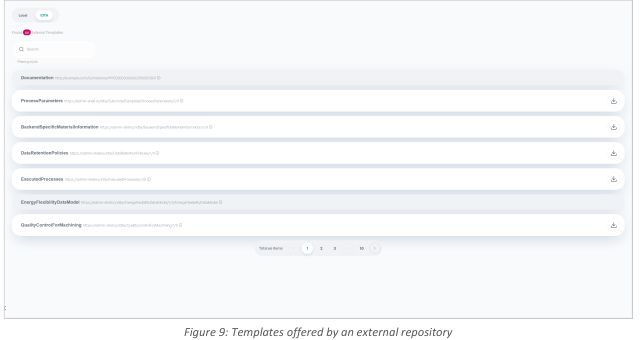
Standardized submodel templates are the foundation of every Digital Twin built on the Asset Administration Shell standard. Until now, these templates had to be imported manually. With DTI 1.2, you can connect external submodel template repositories directly in the settings.
This saves time when creating new submodels. More importantly, customers automatically stay up to date with what these repositories offer, without having to track every update by hand.
This is especially relevant with regard to the IDTA (Industrial Digital Twin Association), which publishes the AAS submodel templates. One of our commitments is: whatever is new in the standard, we also make available in DTI.
Role-Based Access Control (RBAC)
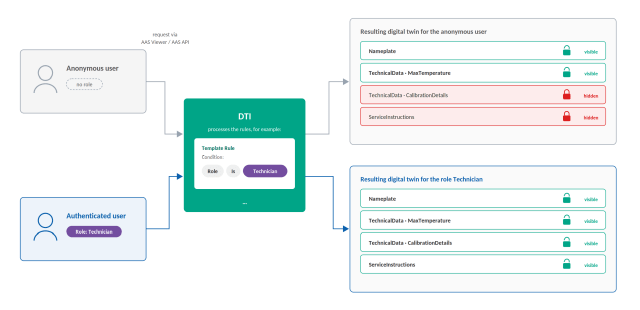
Not every piece of information in a Digital Twin is meant for everyone. With DTI 1.2, our customers get full control over who can see which data.
Roles can be defined freely, for example for service technicians, sales partners, or end customers. Each role gets its own view of the same Digital Twin, down to individual properties of an AAS. Public and private parts coexist: an anonymous request only sees the released content, while an authenticated request additionally sees whatever its role permits.
This lets you show the same twin externally while securing it internally at the same time, without maintaining two separate data models. One QR code, multiple views!
Advanced Filtering in Data Mapping
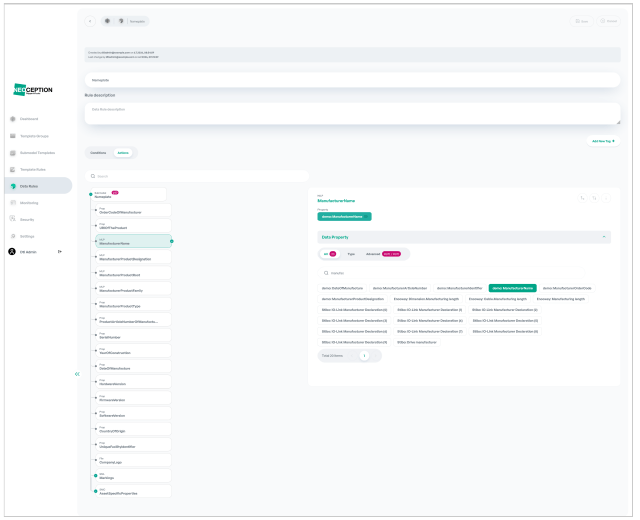
Experience shows that data mapping is the step that requires the most effort when connecting new data sources. This is exactly where advanced filtering comes in for data point selection in the Data Rule Mapping.
Instead of working through long, unstructured lists of data points, the selection can now be narrowed down deliberately. This makes mapping clearer and noticeably faster, especially for large or complex data sources.
Multi-Connector
With DTI 1.2, multi-connector becomes a productive core feature of the platform. Multiple connectors to different source systems can be connected simultaneously in a structured way, each with its own authentication, and one source is designated as the default source.
The effect for the Digital Twin: data points from different source systems, such as ERP, PLM, or MES, are available together for data mapping while remaining distinguishable by origin. For companies with grown, heterogeneous system landscapes, this is an important step toward a more complete data foundation, without having to rely on a single data source.
The multi-connector can be configured through a documented REST interface: each source with its own authentication (Basic or OAuth2), one of them marked as the default source. The complete API documentation is available to your integration team.
Also New
Besides the four major highlights, DTI 1.2 brings a number of smaller but useful improvements:
- Richer data model from the connector. In addition to ID, name, and type, the connector now also provides a description per property, possible semantic IDs per property, and possible filter values. If a semantic already visibly matches another, it is shown higher up during mapping. This is an indication of a possible match, not an automatic mapping.
- Documentation per property. Descriptive documentation can now be delivered directly through the connector.
- Cached queries of the connector structure. The structure of a connected data source no longer needs to be queried anew on every access. By default this happens once every 24 hours, and is configurable or can be disabled. This noticeably reduces the load on the connected source systems.
- Asset kind configurable per instance. Whether an asset is treated as an instance or as a type can now be set per instance instead of only globally. This is especially relevant for type-based use cases.
Availability
DTI 1.2 has been available since August 2026. Existing customers receive the version automatically through our rolling release model, new customers directly with their first deployment. Future version updates of DTI also follow this principle: you don’t need to trigger anything yourself, your instance stays continuously up to date.
Summary
DTI 1.2 makes the Neoception® Digital Twin Infrastructure more capable in four key areas: connecting to the AAS standard, securing content, data mapping, and integrating multiple data sources.
Want to know what DTI 1.2 means for your own Digital Twin strategy? Talk to our team.