Regulations
Digital Product Passport
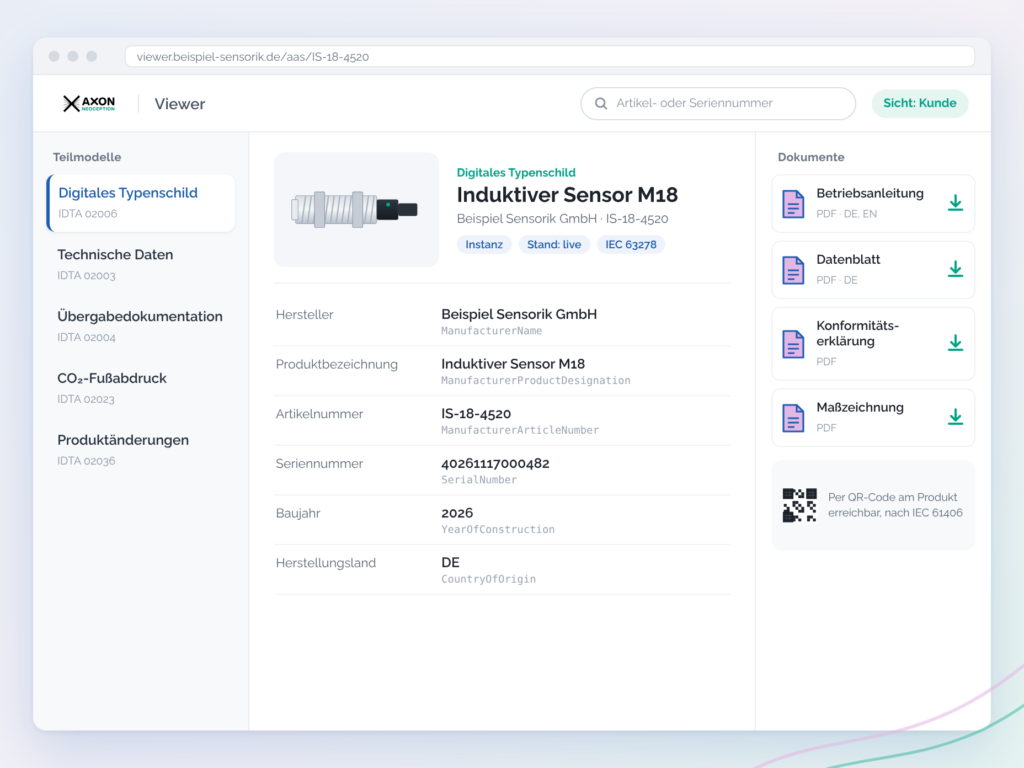
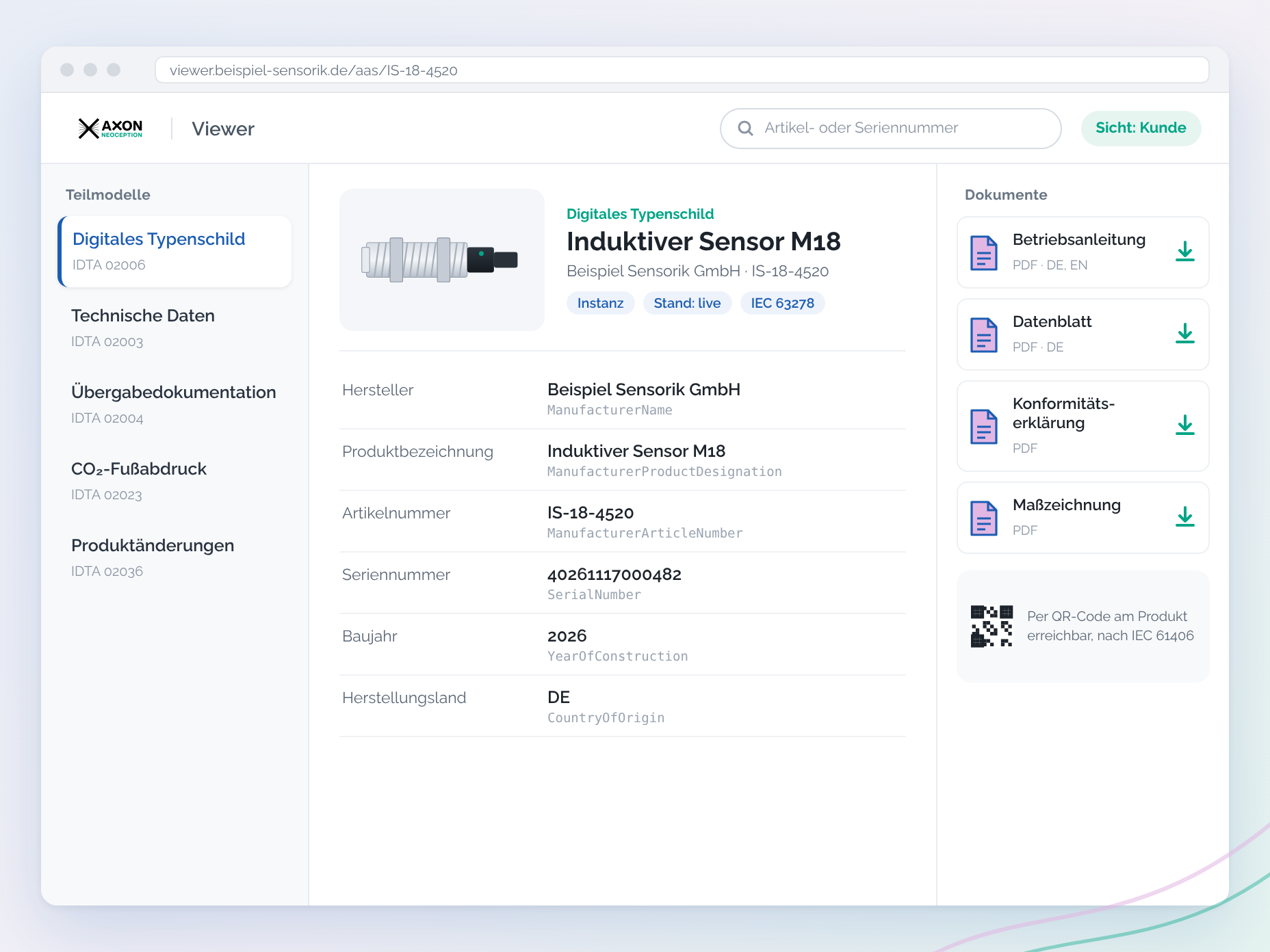
Establish the data infrastructure today that the DPP will require tomorrow. Model new requirements from delegated acts via configuration.
Use case: Digital Product Passport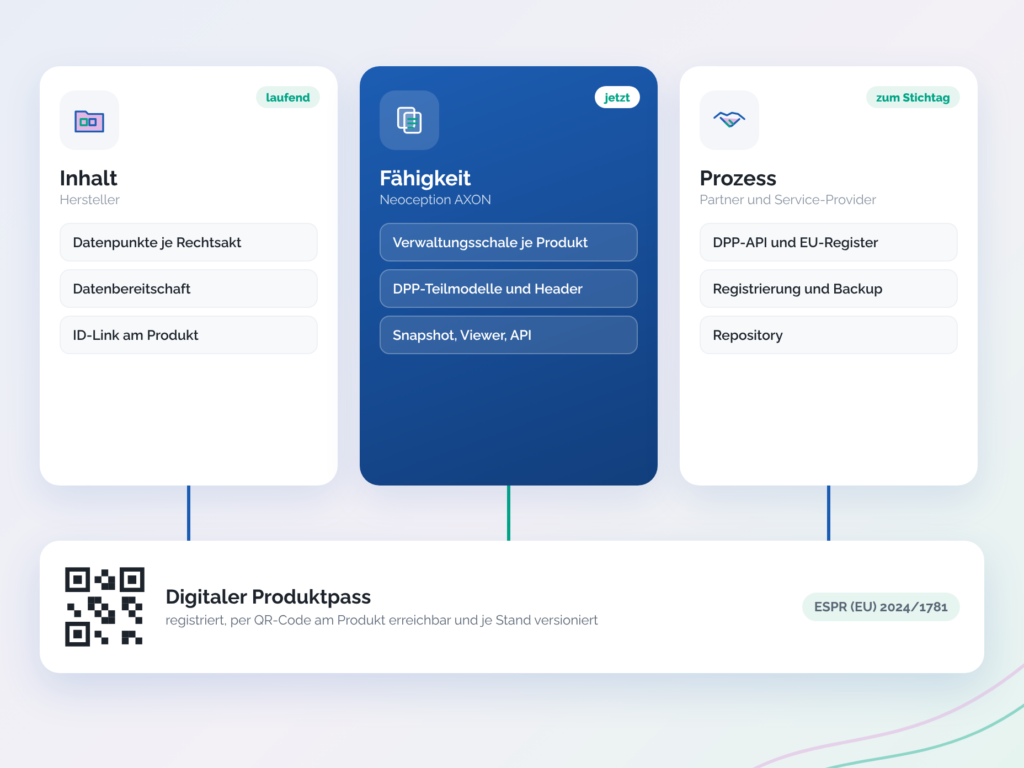
Neoception AXON automatically generates standardized digital twins from your existing systems. For industrial enterprises that want to connect product data once and use it for any use case.
Request Demo
Leading industrial companies use Neoception AXON to provide standardized product data for millions of assets: from paperless product documentation to the battery pass.







Neoception AXON is enterprise software that automatically generates standardized Asset Administration Shells (AAS) from your existing systems. Data from ERP, PIM, PLM, or MES is not copied; instead, it is merged live into an up-to-date Digital Twin for each product upon every request. Through context-based provisioning, such as by role, AXON allows you to control your entire data flow.
Three benefits, one common foundation: Neoception AXON makes industrial data accessible once and reusable for every subsequent use case.
ERP, PIM, PLM, MES, or Data Warehouse: A generic connector framework connects your source systems. Existing systems are integrated rather than replaced, with no migration and no secondary database.
Asset Administration Shells are generated rule-based on demand. The same rule set scales from the initial pilot to a portfolio with millions of products, at both the type and instance levels.
New use cases are configured, not programmed. Your IT department deploys the software once and connects the sources. From then on, business departments implement new use cases independently.
Up to 70% less ongoing IT effort, because new use cases do not trigger new IT projects.
ZIEHL-ABEGG
Paperless product documentation saves 120 tons of paper and 120 tons of CO2 annually.
WAGO
Mapped once to ECLASS. Eliminates the need for additional mapping tools and in-house developments.
Pepperl+Fuchs
Digital instead of printed documentation reduces material and logistics costs per product line.
HEITEC
The EU Battery Regulation becomes a bookable add-on for your own IoT platform.
USE CASES
Connected once, used widely: The same infrastructure supports the Digital Product Passport (DPP) and your Product Change Notifications (PCN), while also serving the Digital Data Chain (DDC). Every additional use case is a matter of configuration, not a new IT project.
Regulations
Establish the data infrastructure today that the DPP will require tomorrow. Model new requirements from delegated acts via configuration.
Use case: Digital Product Passport
Regulations
Mandatory for batteries over 2 kWh starting February 18, 2027. AXON provides the required product data in a structured and standardized format based on the AAS.
Use Case: Battery Pass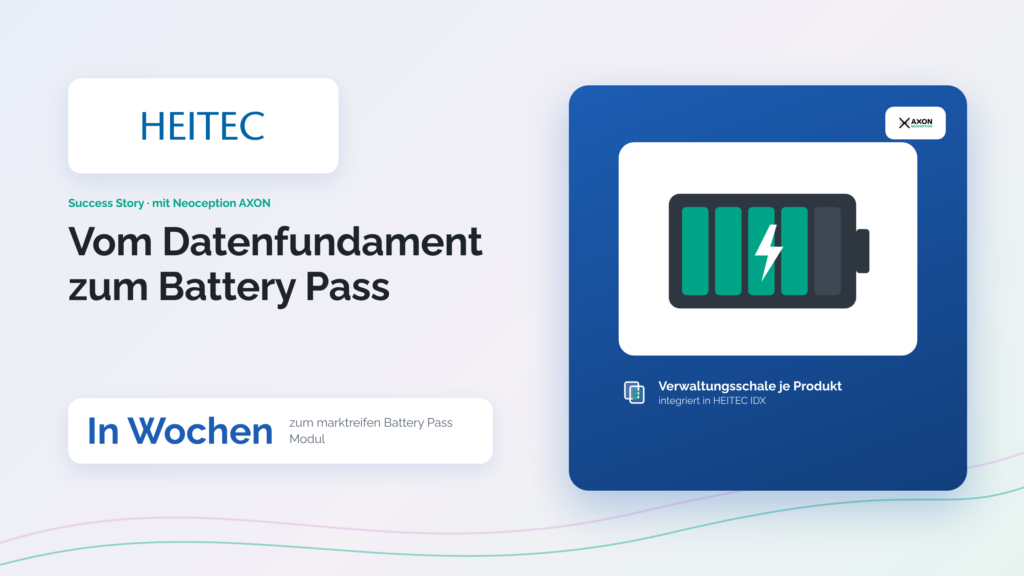
Processes
Communicate product changes to your customers in a standardized and machine-readable format, based on the IDTA submodel for Product Change Notifications.
Use Case: Product Change Notification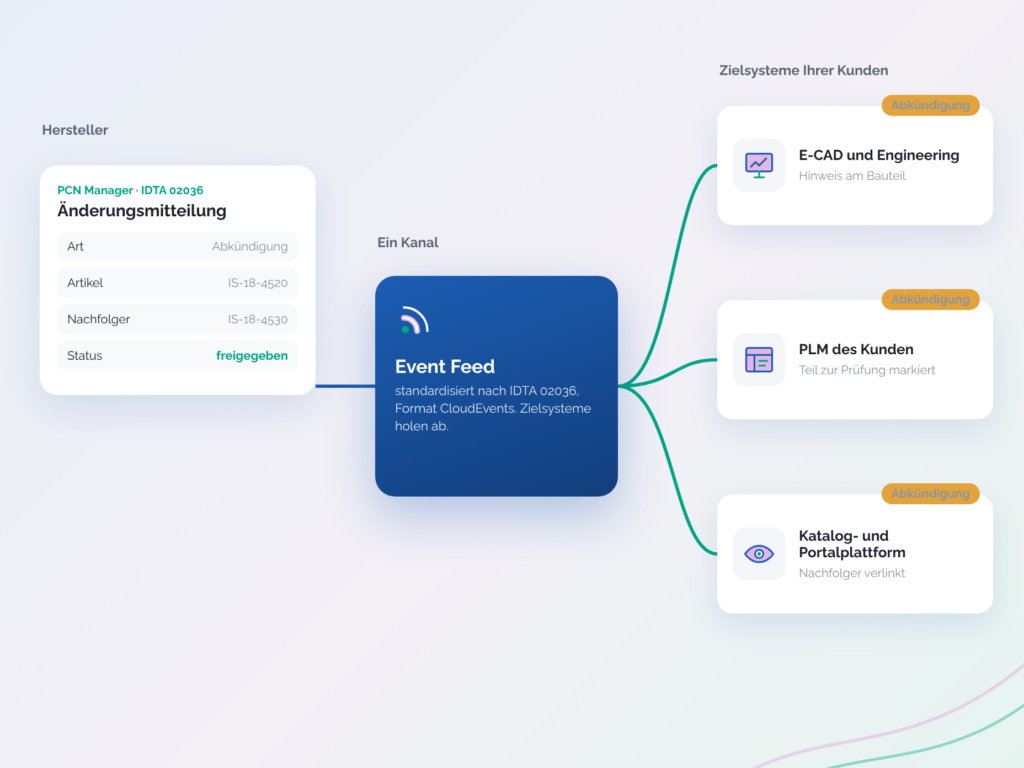


Our advice to other companies: concretize the use case early on and then try it out. This quickly reveals potential and makes getting started much easier.


Our goal was not only to meet regulatory requirements, but to embrace them as an opportunity for added value and innovation.
NEWS & INSIGHTS
Partnerships, customer projects, events, and product updates related to the Asset Administration Shell, the Digital Product Passport, and Neoception AXON.
Partnerships
Partnership agreement signed: D&TS prepares master data according to ECLASS, and Neoception AXON generates Asset Administration Shells from it.
To the article: D&TS and Neoception seal partnership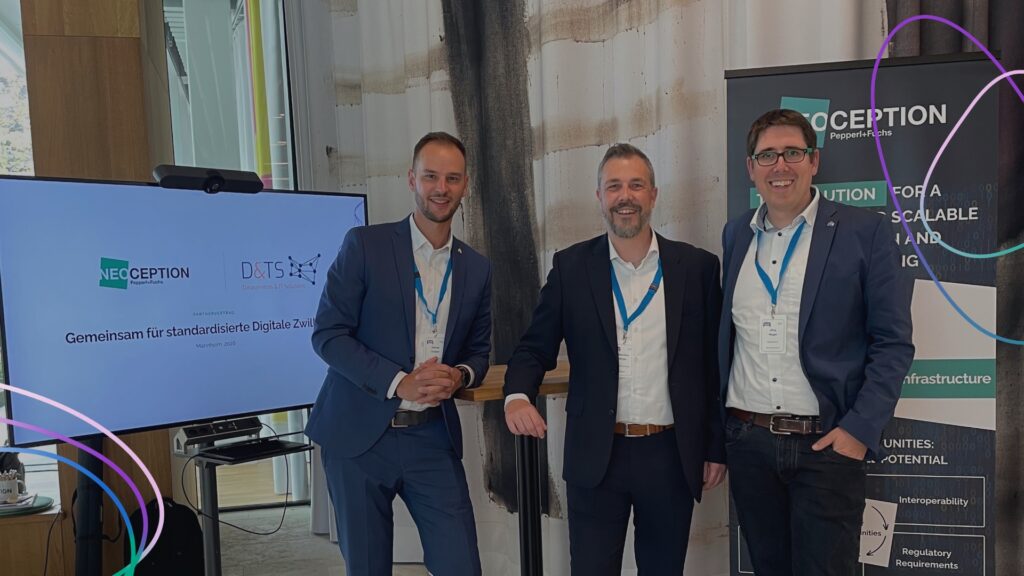
Events & Webinars
Eight manufacturers, two days in Mannheim, one finding: The technology works. The hurdle in the AAS rollout lies in the data and organization.
Read article: Community Days 2026: The hurdle lies in the data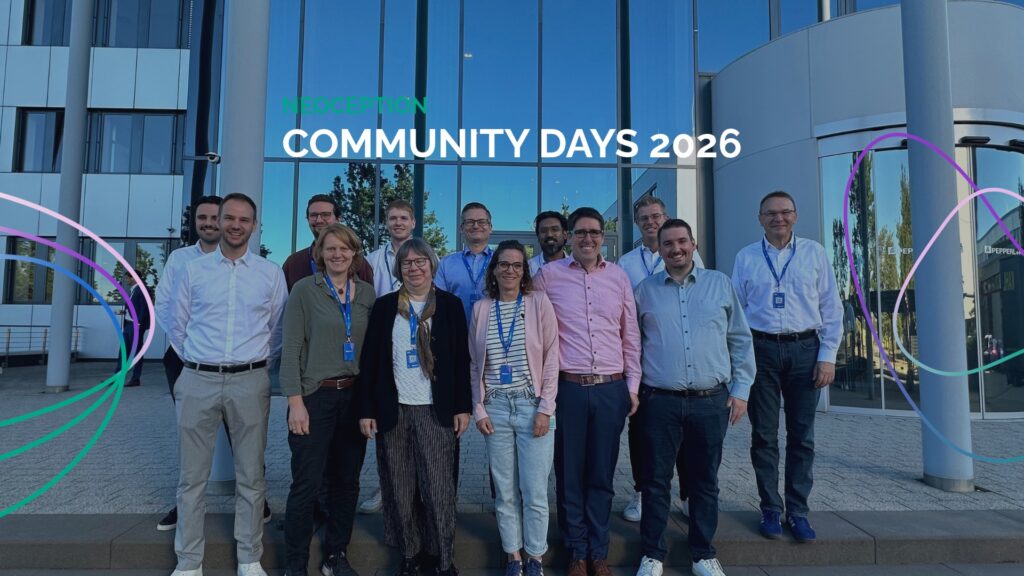
Events & Webinars
November 24 to 26, 2026, Nuremberg: Neoception AXON and the PCN Manager at the IDTA booth, Hall 5, Booth 358. Free ticket available through us.
To the article: Neoception AXON at SPS 2026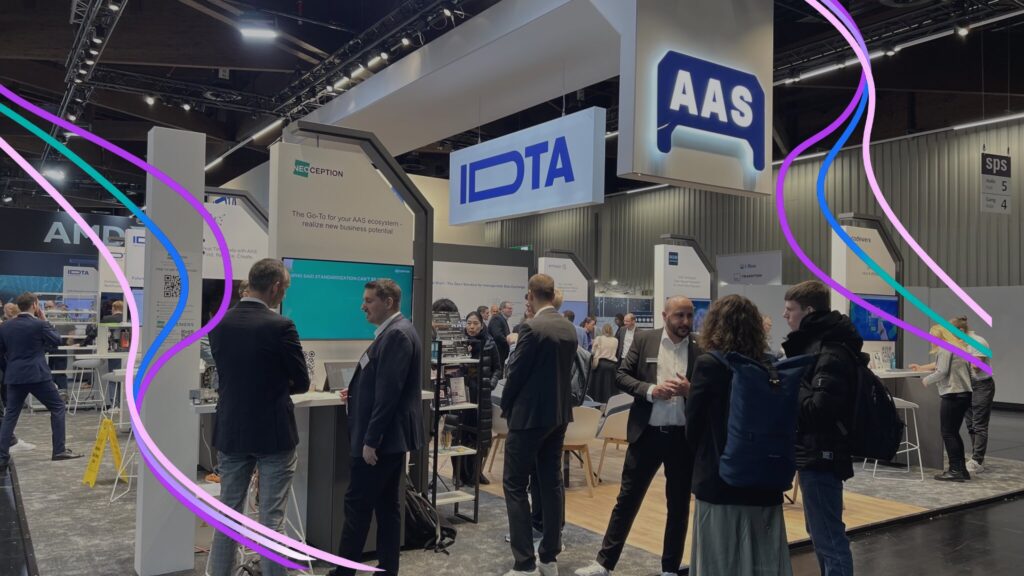

Would you like to see how your data is turned into standardized Digital Twins? In a live demo, we will show you Neoception AXON using an example from your industry.
Free and without obligation.
Briefly let us know which systems and which use case you are working with. We will get back to you shortly with a proposed date.


The most important answers at a glance. Detailed explanations regarding the Asset Administration Shell, Digital Twin, and Digital Product Passport can be found in the FAQ.
View all FAQsThe Asset Administration Shell (AAS) is the global, open standard (IEC 63278) for the industrial Digital Twin. It defines a uniform format and standardized interfaces through which all information regarding a product or asset is provided in a structured manner: from technical documentation and material data to certificates. In industry, the AAS is considered the preferred technology for implementing the Digital Product Passport (DPP).
Neoception AXON is enterprise software that automatically generates standardized Asset Administration Shells at scale, based on the data already present in your systems. Instead of redundantly copying data, AXON generates Asset Administration Shells rule-based and on-demand directly from your source systems. This transforms distributed data from ERP, PIM, PLM, or MES into a consistent, always up-to-date Digital Twin for each product or asset. Neoception AXON was formerly known as Digital Twin Infrastructure (DTI).
Neoception AXON is designed for manufacturing companies that need or want to provide standardized product and asset data on a large scale: due to customer requirements, regulatory specifications such as the Digital Product Passport or Battery Pass, or to digitize internal processes. The software can be used across industries and is conceived for industrial environments, including established brownfield landscapes.
Typical use cases include the Digital Product Passport (DPP), the Battery Pass, paperless product documentation according to VDI 2770, the digital nameplate, Product Change Notifications, and Asset Lifecycle Management. The decisive advantage: Neoception AXON is an infrastructure for all these use cases simultaneously. Once connected, you can add new applications via configuration without having to start a new IT project for each one.
No. Neoception AXON operates without redundant data storage. Your source systems remain the single source of truth, and the Asset Administration Shell is generated from the live data with each retrieval, ensuring information is always up to date. For use cases with compliance and reporting obligations, the snapshot application also preserves time-stamped Asset Administration Shells in a repository.
Yes. The AAS is widely regarded in industry as the preferred technology for implementing the DPP. With Neoception AXON, you establish the data infrastructure today that the DPP requires tomorrow: requirements are modeled via configuration, and the snapshot application already provides mechanisms for persistent product passports. The DPP is just one use case among many; the same infrastructure also supports your other digitalization initiatives.
Yes. With the trial license, you can use Neoception AXON as a full-featured SaaS solution on a test database for three months, without your own infrastructure and without installation effort. This allows you to risk-free test whether the software fits your data landscape and use cases. Configurations, templates, and connectors from the test phase can be transferred to productive operation.
You are currently viewing a placeholder content from Hubspot Embedded Content. To access the actual content, click the button below. Please note that doing so will share data with third-party providers.
More InformationYou are currently viewing a placeholder content from HubSpot. To access the actual content, click the button below. Please note that doing so will share data with third-party providers.
More InformationYou are currently viewing a placeholder content from Hubspot Meetings. To access the actual content, click the button below. Please note that doing so will share data with third-party providers.
More Information