At a Glance
- Format: Interview in the Pepperl+Fuchs magazine amplify (excerpt)
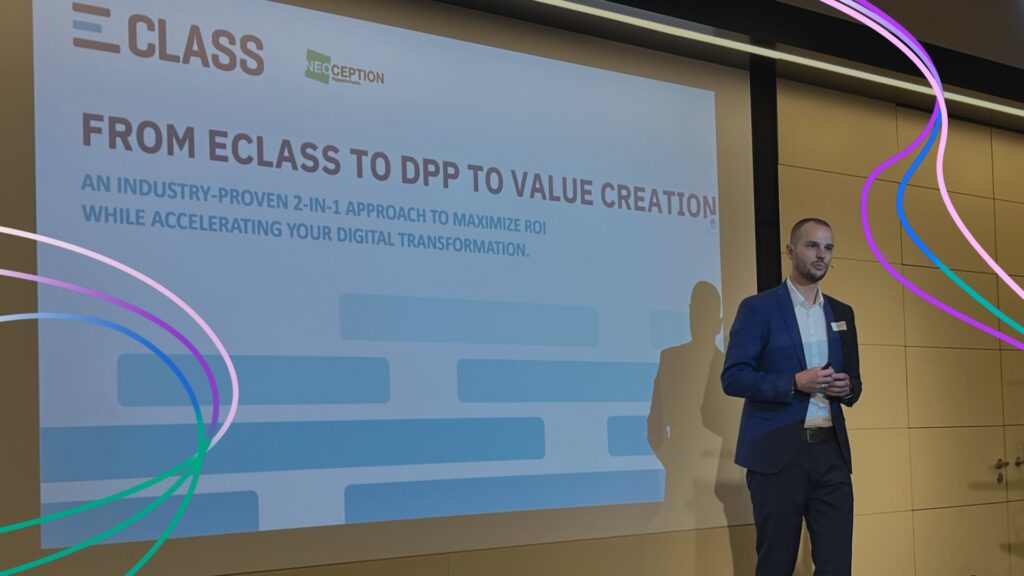
- Interviewee: Adrian Grüner, Director of Sales Excellence, Neoception
- Topic: Digital Twin, Asset Administration Shell, and Standards
Making business processes more efficient, especially near production, is Neoception's daily challenge. What do concrete approaches for efficient production of tomorrow look like, and what role does the Digital Twin play in this? Adrian Grüner discusses this in the Pepperl+Fuchs magazine amplify.
When Adrian Grüner looks out the window of his office at the Neoception site in Mannheim, he sees all kinds of manufacturing companies, ranging from small businesses to large corporations. As Director of Sales Excellence, he asks himself daily how he can support small and medium-sized enterprises in particular to make their manufacturing processes more efficient and operate more sustainably.
Because while greater efficiency in production saves time and money, legislators are increasingly demanding compliance with sustainability targets and proof of the sustainability of individual products. Transparency across a product's entire supply chain is a prerequisite for both.
Neoception uses Neoception AXON to help companies capture the required data and provide it centrally in an industry-standard format, making it accessible not only to manufacturing companies themselves, but also to their customers and other stakeholders.
Buzzword "Digital Twin"
Mr. Grüner, what exactly is meant by the buzzword "digital twin"?
The digital twin is a virtual representation of a specific asset, whether that is a physical product, a plant, a process, or a system. However, this should not be thought of simply as a static image, as the digital twin is much more comprehensive. The term "Asset Administration Shell" (AAS)—frequently used in the context of Industry 4.0 to describe a standard for a digital twin—fits this well: all information regarding that specific asset is made available in a standardized format at a single digital location. In addition to product information, manuals, and data sheets, this will increasingly include real-time data, simulations, and analytics.
Do you have a tangible, real-world example?
A classic, illustrative example that we are currently working on together with Pepperl+Fuchs for their proprietary product portfolio is ...
Read the full interview in the Pepperl+Fuchs magazine amplify.